ET Desk: Roundtable in Dhaka Calls for Turning Girls’ Voices into Decisions and Action
ECS-Education & Cultural Society brings together policymakers, educators, researchers and civil society to discuss girls’ agency in Bangladesh
ECS-Education & Cultural Society organized a roundtable discussion on girls’ agency at the Risotto Hall of Hotel Sarina in Banani, Dhaka, on Thursday, October 1, 2026. The event brought together parliamentarians, government officials, academics, educators, development practitioners, journalists, business leaders and youth representatives to discuss how Bangladesh’s wider ecosystem can create more space for girls’ voice, choice and influence.
Opening
Barrister Zahin Morshed welcomed the participants and presented a video on ECS’s journey across different fields. The video also covered the Action Research of the Learning and Action Alliance for Girls’ Agency (LAAGA), conducted by ECS in Feni in collaboration with the Center for Universal Education at The Brookings Institution.
Moderator’s Framing
The discussion was moderated by Ms. Kazi Nasrin Siddiqa, Executive Director of ECS, Echidna Global Scholar of the Brookings Institution, former consultant of the World Bank and Research Consultant of the LAAGA Action Research. She explained that the girl-centered, participatory research carried out over three years in Feni treated girls as co-creators of knowledge and agents of change rather than as research subjects. She stressed that agency is shaped by family, school, social norms, economic circumstances, climate, migration and institutions, and that responsibility cannot be placed on girls alone. She described ECS’s aim as building a bridge “from the last mile to the top floor,” so that evidence from the field reaches policy.
Key Discussant
Barrister Jahrat Adib Chowdhury MP, Chairman of the Parliamentary Standing Committee on the Ministry of Foreign Affairs, was the key discussant. She shared her experience on girls’ agency and expressed her commitment to work for the betterment of girls. She extended her solidarity with ECS’s work on girls’ agency and her support for the children of JONAKI, the ECS-operated learning center in Gazipur.
Highlights from the Discussion
Professor Sheikh Tahmina Awal of the Institute of Education and Research (IER), University of Dhaka, spoke on the necessity of education and empowerment of girls and young women for national development.
Ms. Samira Bari, Vice President of ECS and former Assistant Head Teacher of Viqarunnisa Noon School, shared her experience with ECS projects, highlighting girls’ representation in STEM and Environment STEM education. She also spoke about the opportunities and responsibilities of civil society organizations in supporting girls to exercise agency.
Angelina Tanlet, Partnership & Fundraising Project Leader of LP4Y, said girls and young women can achieve more with support in building skills for job transition, as LP4Y is providing in Bangladesh.
A.H.M. Emranul Haque, Head Teacher of B.S.N. School & College, Feni, a key stakeholder in the LAAGA Action Research, spoke about Feni’s social and geographical importance and the resilience and potential of its girls. He emphasized opening Girls’ Agency Clubs in Feni and organizing the Girls’ Agency Carnival planned under the research project.
Shameem Ara Sheuly, Bangladesh Coordinator and Mentor at EJN, Internews, stressed the need to share the findings of ECS’s action research widely. She committed to support taking the news to the policy level to ensure agency for girls from marginalized communities.
Mamun Morshed, Deputy Director (Training), Directorate of Secondary & Higher Education (DSHE), identified early marriage as a leading cause of dropout among both girls and boys in rural and semi-urban areas. He noted that early marriage brings wider social harm, including frustration and violence linked to dowry. He said the present government has taken initiatives to provide skill-based education and training, including for dropped-out students, and that the Prime Minister has emphasized a third language so that skilled workers can find good jobs abroad.
Engineer Lutful Bari, Advisor to ECS and former Chemical Engineer at Unilever, called for stronger communication and support within and among girls’ communities, and appreciated the research initiative.
Rafikul Islam Jewel, Vice President of Asia Insurance PLC, highlighted the financial freedom of girls and expressed support for ECS’s projects, including the JONAKI Learning Center.
Ms. Tiva Tasha, Master’s student of Development Studies at IUB, observed that women can be both a source of support and a source of obstacles for girls, and that women therefore have a vital role in restoring girls’ agency.
Sayed Amin Sameer, Head of Communication, Nagorik Protidin, spoke in support of girls’ agency.
Mr. Mahbubur Rahaman, a school teacher in New York, said girls in Bangladesh do not get the same opportunities as girls in advanced countries and are unable to realize their full potential.
Voices of Young Women
Young participants shared personal experiences that gave the discussion its human dimension.
Sumaiya Ador, a female activist of the Bangladesh Nationalist Party, became emotional as she spoke of the political killing of her father during the fascist regime. She said she fought alone after his death and established herself by completing her education, but could not help her younger sister complete hers. She urged girls to be stronger in facing society’s challenges.
Tayeba Taha, a student leader of Eden Mohila College, Dhaka, said she overcame countless obstacles to travel from Bandarban to Dhaka to continue her education, in the face of disapproval from family and society and intense pressure for early marriage. She said her brother’s support helped her exercise her agency.
Mitu Akhter, Program Executive of ECS and Facilitator at the JONAKI Learning Center, spoke about girls who continue their studies despite immense pressure to marry early. She said society treats girls like vegetables: fresh in the morning, fetching a higher price if married off early, but “perished” by the afternoon if they keep studying and are seen as less likely to find a good husband. “This is what our girls face every day, let alone exercising their agency,” she said.
Closing
Concluding the session, Ms. Kazi Nasrin Siddiqa said girls’ agency is not a destination but a continuing process of creating conditions in which girls can speak, choose, participate, influence and act. She noted that the bridge between evidence and policy works only when people are willing to cross it. ECS will document the key insights and action points as part of its Knowledge-to-Action process.
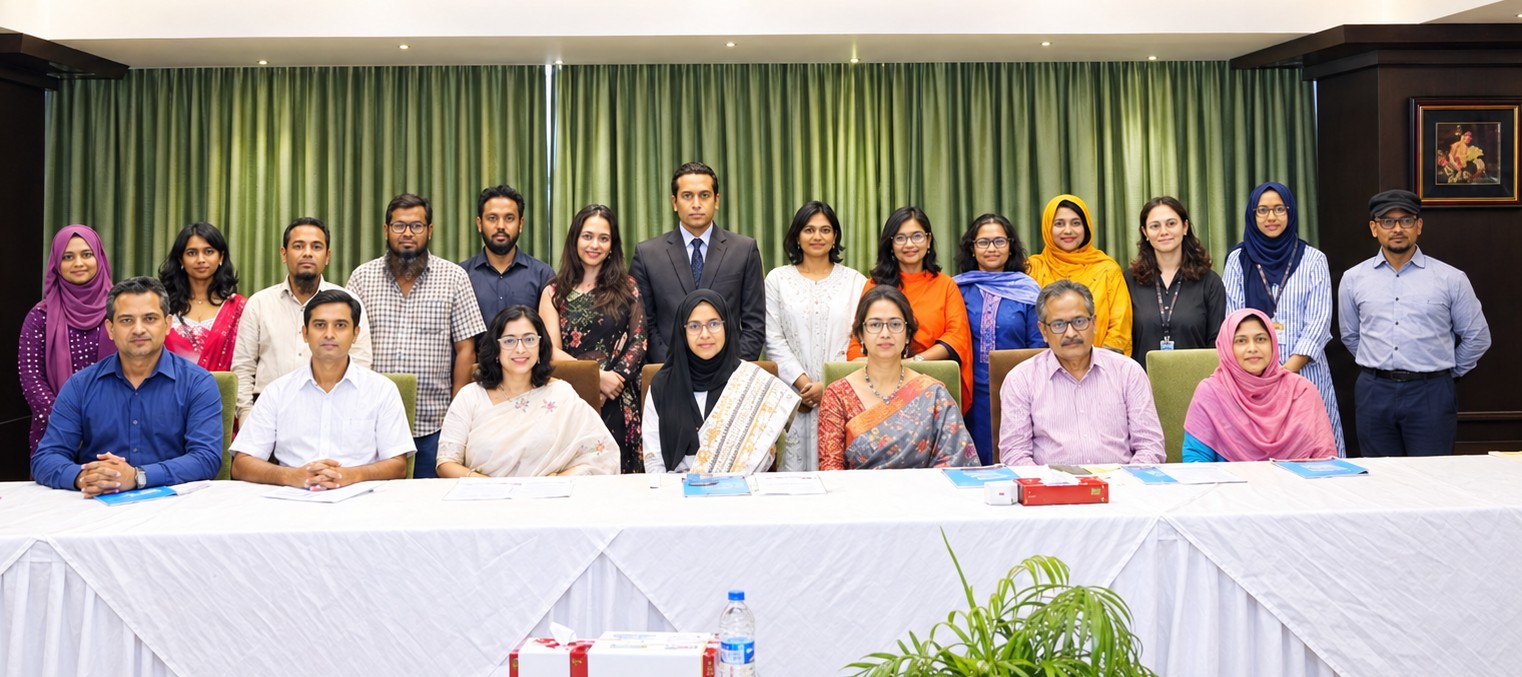
Nur Alam, Advisor to ECS, expressed his solidarity, and Mr. S. M. Nahid, Project Coordinator of ECS, was also present. The event concluded with a group photo session and a buffet lunch.
About ECS-Education & Cultural Society
For more than 15 years, ECS has worked with children, girls, teachers, families and communities at the grassroots level, connecting this experience to research, national dialogue and international learning.
About LAAGA
The Learning and Action Alliance for Girls’ Agency (LAAGA), working with the Center for Universal Education at The Brookings Institution since 2022, brings together researchers and practitioners across Africa, Asia, the Middle East, the Americas and other regions to co-create knowledge about girls’ agency and turn it into action.