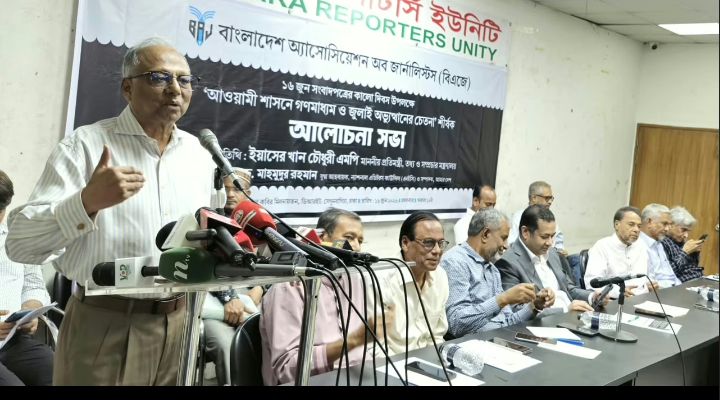
SM Tajul Islam: Dr. Mahmudur Rahman, Joint Convener of the National Editors’ Council and Editor of Amar Desh, has described Sheikh Mujibur Rahman as “the icon of fascism in independent Bangladesh.”
He made the remarks on Tuesday (June 16) while speaking at a discussion titled “Media Under Awami Rule and the Spirit of the July Uprising,” organized by the Bangladesh Association of Journalists (BAJ) at the Shafiqul Kabir Auditorium of the Dhaka Reporters Unity (DRU), marking the observance of the Black Day of Newspapers.
Mahmudur Rahman said Sheikh Mujib began the journey of independent Bangladesh by dismissing legendary editor Abdus Salam from his job. According to him, the history of the Awami League is a history of autocracy evolving into fascism.
“I divide Sheikh Mujib into two phases: Sheikh Mujib of the Pakistan era and Sheikh Mujib of independent Bangladesh. To me, the Sheikh Mujib of independent Bangladesh was an icon of fascism. Fascism always requires an icon to legitimize itself,” he said.
He alleged that since the July Revolution, efforts have been made to separate Sheikh Mujib from Sheikh Hasina in an attempt to rehabilitate the Awami League politically. “There is no difference between Sheikh Mujib and Sheikh Hasina,” he asserted.
Explaining his position, Mahmudur Rahman said Sheikh Mujib was in power for only three and a half years, whereas Sheikh Hasina ruled for more than 20 years. “Had Sheikh Mujib been given 20 years in power, he would have taught Sheikh Hasina how to practice fascism,” he remarked.
He further claimed that during both Sheikh Mujib’s and Sheikh Hasina’s administrations, the media was turned into a “factory for producing sycophants.” Comparing the media environments of 1972–1975 and the past 15 years, he said there was no difference in the level of political flattery and loyalty displayed by sections of the press.
Warning those attempting to rehabilitate the Awami League, he said, “Anyone trying to portray Sheikh Mujib as a better politician or a better person than Sheikh Hasina in order to restore the Awami League should understand that, to me, Sheikh Mujib is nothing more than an icon of fascism. There is no scope for rehabilitating such an icon.”
Referring to June 16 as a “Black Day,” Mahmudur Rahman said it symbolizes Sheikh Mujib’s legacy of curtailing democratic rights and suppressing freedom of expression. He alleged that many of the authoritarian practices associated with Sheikh Hasina’s rule had their origins during Sheikh Mujib’s tenure from 1972 to 1975.
He also described the former Jatiya Rakkhi Bahini as the “father of RAB,” arguing that discussions on alleged state repression should not overlook the role of the paramilitary force established during Sheikh Mujib’s government.
Calling on journalists to move away from political sycophancy, Mahmudur Rahman stressed the need for self-criticism and professional integrity. He argued that journalists must maintain independence and resist political interference in media affairs.
“The job of the media is to ask questions. Never compromise on your right to question those in power,” he told journalists. “Only when we can stand upright and tell politicians not to interfere in professional matters will true media freedom become possible.”
The discussion was chaired by BAJ President and former Bangladesh Federal Union of Journalists (BFUJ) President M. Abdullah. Information and Broadcasting State Minister Yaser Khan Chowdhury attended the event as the chief guest.
A keynote paper titled “Media Under Awami Rule and the Spirit of the July Uprising” was presented by noted columnist and former Vice-Chancellor of Patuakhali Science and Technology University, Professor Dr. Abdul Latif Masum.
In his paper, Professor Masum argued that political systems ultimately depend not only on administrative power or electoral majorities but also on public consent, social legitimacy, and credible information flows. Citing Italian political philosopher Antonio Gramsci’s theory of cultural hegemony, he noted that governments rely on ideological state apparatuses, including the media, to sustain power.
According to Masum, the July Uprising of 2024 demonstrated that when media institutions lose touch with public realities, people create their own language of resistance on the streets. He emphasized that Bangladesh’s future democratic and constitutional journey will require an independent, courageous, and trustworthy media capable of speaking truth to power and holding rulers accountable.
He concluded by saying that the sacrifices made during the July Uprising serve as a reminder that truth may be suppressed temporarily, but it can never be defeated permanently.