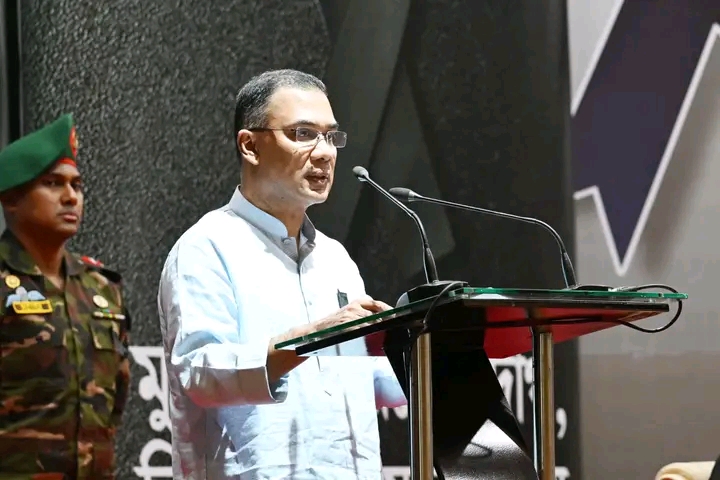
“After a long struggle, a government elected by the people’s verdict is now in power. On issues concerning the country, we will further modernise and consolidate the border force. And our (border force) members will perform their duties with patriotism and professional excellence,” he said.
The premier made the remarks while speaking at a views exchange meeting at the Army Multipurpose Complex in the Army Headquarters here this afternoon on the occasion of the National Martyred Army Day commemorating the BDR (Now BGB) carnage on February 25 and 26 in 2009.
Home Minister Salahuddin Ahmed, Chief of Army Staff General Waker-Uz-Zaman, Border Guard Bangladesh (BGB) Director General Major General Mohammad Ashrafuzzaman Siddiqui and family members of Pilkhana carnage martyrs spoke on the occasion.
Prime Minister’s Defence Adviser Brigadier General (retd) Dr AKM Shamsul Islam, Chief of Naval Staff Admiral M Nazmul Hassan, Chief of Air Staff Air Chief Marshal Hasan Mahmood Khan, Prime Minister’s Principal Secretary ABM Abdus Sattar and senior officers were present.
Prime Minister Tarique Rahman’s spouse Zubaida Rahman and daughter Zaima Rahman were also present.
Referring to the historic roots of the border force, he said that they are embedded in the nation’s independence.
“On March 26, 1971, when Shaheed President Ziaur Rahman proclaimed independence from Kalurghat Betar Kendra in Chattogram, members of the then EPR were on duty alongside the Army and witnessed that historic moment,” Tarique Rahman said.
Since the beginning of the great Liberation War, the border force along with the Bangladesh Army has been making unforgettable contributions to the country, he added.
Later, the premier said, Shaheed President Ziaur Rahman placed special emphasis on strengthening the border force through infrastructural development and reforms.
The number of qualified and talented army officers sent to BDR on deputation was increased, he said, adding, in 1978, the force was reorganised in military fashion, with wings converted into battalions and two new battalions added, marking a significant milestone in its history.
At the onset of his speech, Tarique Rahman recalled the valiant martyrs of the 1971 Liberation War, those who sacrificed their lives in the 1990 mass uprising and the 2024 mass uprising with due respect.
He also paid deep tribute to the 74 brave martyrs, including 57 patriotic army officers, who embraced martyrdom in the brutal killings on February 25 and 26 in 2009 at Pilkhana in the city, the then BDR (now BGB) headquarters.
The premier prayed for the eternal peace of the souls of the martyrs and conveyed profound condolences to the bereaved families.
Describing February 25 as a bloodstained and grief-stricken day in the nation’s history, the Prime Minister said that whenever this day comes, nature itself seems to fall silent under the weight of memory and mourning, and the air carries the cries of that horrific moment.
“The brutal incident of February 25 and 26 in 2009, left a deep wound in our national life, the pain of which still lingers today, despite the passage of time,” Tarique Rahman said.
“Standing on the grounds filled with the memories of the martyrs today after 17 years of the incident, my voice is growing heavy. I came before you not only as an elected public representative but also as a member of an army family and as the son of a fellow soldier,” he added.
Noting that in that horrific incident of 2009, 74 lives were lost, including 57 talented and patriotic army officers, the premier said each name represents the extinguishing of a family’s light, the painful chapter of losing a loved one, the history of a child becoming fatherless and an unfinished epic of dreams.
“When I visited the graves of the martyred army officers at Banani Military Graveyard after returning to the country, I realized your unbearable struggle, immense sacrifice and the agony of seeking justice over the past 17 years,” Tarique Rahman said.
Stressing that remembering the Pilkhana tragedy with state honor is a national responsibility, he said, “If we do not give national recognition to the incidents of February 25 and 26 in the history, future generations will not forgive us”.
Therefore, the premier said the current government will work to preserve the memory of those days.
About the army, he said the army has a glorious history in Bangladesh’s Liberation War and in the nation-building after the independence, adding, “Army is the symbol of our sovereignty. I think, the Pilkhana tragedy was an ill-attempt to foil that sovereignty”.
Stating that the Pilkhana incident exposed the weaknesses of the country’s national security framework, the Prime Minister put emphasis on making national security framework more modern, timely and strong, keeping pace with the globe.
“Our government will work toward this goal. Simultaneously, we reiterate our commitment to establish long-term security arrangements for the education, treatment, and rehabilitation of the children of martyred families,” Tarique Rahman said.
Later, the prime minister took iftar with Pilkhana carnage martyrs’ families.