Md. Mahbubul Alam Shaun
All parents and grandparents aspire to have the best child possible. They hope their child will have exceptional intelligence and achieve remarkable results in all areas of life. As a result, they devote a great deal of time, money, food, education, sports, and other resources to their child. Early on, they began to provide wholesome meals, enroll students in prestigious schools, and set up extracurricular programs to promote social and mental growth. These days, it’s not uncommon to see a toddler carrying a large bag that they can’t even lift. For four to five years, the youngster receives tutoring from multiple teachers. All of these to make them high-profile students for demonstrating outstanding class performance. In particular, grandparents are more concerned about the food that their grandkids eat. Most of them, nevertheless, are even unaware of the science underlying human brain development.
The central nervous system (CNS) develops extensively during the prenatal period and the first year of life a. There is strong evidence that long-term brain functional ability is determined by neural developmental milestones. Long-chain polyunsaturated fatty acids (LCPUFA) are necessary components of the rapidly expanding perinatal central nervous system, according to basic research. The primary ingredient for neural or brain growth is omega-3, also referred to as long-chain polyunsaturated fatty acid (n-3 LCPUFA). More precisely, during the 600 million years of animal history, docosahexaenoic acid (DHA) has been the only n-3 fatty acid utilized as a significant structural and functional component of the photoreceptor, neurons, and their signaling synapses.
The Food and Agriculture Organization of the United Nations (FAO) states that it might be too late to use LCPUFA to treat neurological and neuropsychological conditions once brain milestones have been reached. This implies that even if parents or grandparents give their kids wholesome food if they don’t get DHA from their breast milk and during fetal development, their brains might not be able to develop further.
It is believed that n-3 PUFA assists control of neurotransmitters and allows fluidity in neural membranes. Although the placenta satisfies the extra fetal need for long-chain PUFA, mothers who have insufficient n-3 PUFA storage may be able to transfer this poor condition onto their unborn children. The recommended nutrient intake (RNI) of DHA for pregnant and lactating women (PLW) is 200–300 mg/d. According to the current research, mothers of exclusively breastfed newborns typically provide their babies 110 mg/d of DHA. Consumption of n-3 PUFA diets during pregnancy can improve the mother’s DHA status, which is potentially advantageous to the fetus. Following delivery, the mother’s fatty acid status continues to influence her infant through breast milk, which is a naturally abundant source of DHA. Breast milk reflects the mother’s frequent diet of fatty acids; for example, vegans’ breast milk has comparatively low levels of DHA, whereas mothers who regularly consume fish produce breast milk with high levels of DHA.
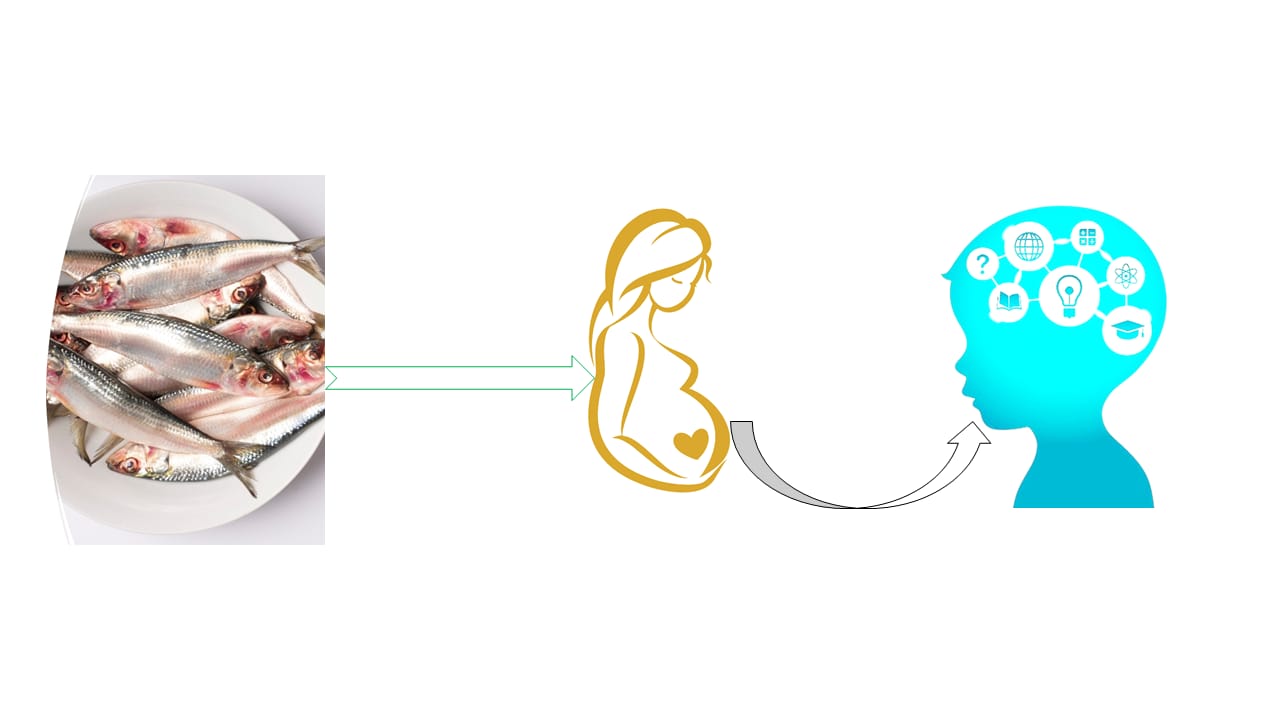
A great source of DHA is fish. Regular consumption of fish or fish oil during pregnancy raised plasma DHA levels in pregnant women and enhanced the quantity of n-3 PUFA transmitted to the fetuses. Nonetheless, a lot of fortified foods in developed nations and cities are said to contain DHA. Even if such are already available in Bangladesh, they are very expensive, unavailable in rural areas, and out of reach for lower-income households. Rather, Sardine, a small marine pelagic fish that is known locally in Bangladesh as Chapila, has a high DHA concentration. Although it is widespread in our coastal region, it may now be found far from the coast. It is relatively cheap, usually costing between 100 and 150 BDT per kilogram, but in supershops or ready-to-cook (RTC) form, it can cost up to 300 BDT per Kg. But affluent customers mostly overlook it to buy. According to a study conducted by Anna Nordhagen of the Institute of Marine Research in Norway and her colleagues, 100 g of edible sardine from the Bay of Bengal contains 0.29 g of DHA. This suggests that daily consumption of 100 g of sardine fish can satisfy a PLW’s daily RNI by 100%. Even if a PLW has a problem with fish bones, she can still eat dried sardine fish powder. Ready-to-use fish powder (RUFP) from dried sardine fish was created by a team led by Professor Abdullah Al-Mamun, PhD, of the Department of Fisheries and Marine Science at Noakhali Science and Technology University. According to this study, 100g of dried fish powder for the muscle portion has 1137.29 mg of EPA+DHA (EPA-Eicosapentaenoic acid, another n-3 LCPUFA). This suggests that PLW can get the recommended daily intake of DHA from about 30g of RUFP consumption a day. Regular consumption of cheap and readily available sardine fish or dried sardine fish powder by PLWs will guarantee their children’s cognitive development.
Written by:
Md. Mahbubul Alam Shaun
B.Sc. (Honors) & MS in Nutrition and Food Science
PhD Research Fellow
DANIDA-funded AQUAFOOD Project
Department of Fisheries and Marine Science
Noakhali Science and Technology University